If you’ve ever spent a weekend hauling soil, garden tools, or bagged mulch around your yard, chances are you’ve got a garden cart in your garage or shed—one of those rugged, wheeled workhorses that seems designed to handle just about any outdoor heavy lift. Recently, I’ve gotten dozens of questions from customers who’ve started combining their garden cart’s utility with their kids’ latest project: “Can I use a garden cart to transport my child’s playhouse?” It’s a question that makes total sense. Playhouses are bulky, often made of lightweight but fragile wood, plastic, or composite panels, and they feel like the perfect thing to move with a cart that’s already built for hauling big loads. But before you grab your power drill and start dismantling that adorable wooden playhouse your kid has been begging for, let’s break this down—no guesswork, just practical, science-backed reasoning from a garden cart supplier who’s been testing these products in real yards for years. Garden Carts
First, let’s get clear on what we’re actually talking about here. A typical child’s playhouse isn’t a single, rigid structure—most models, especially the larger, outdoor ones, are designed to be assembled on-site, with separate panels for walls, a roof, a floor, and trim. Even the smaller, plastic-style playhouses (think the ones with a tiny door and two windows) come in 4 to 6 distinct pieces that weigh anywhere from 20 to 50 pounds each, depending on material. Garden carts, on the other hand, are engineered to carry loads of 300 to 1,200 pounds, depending on the model, so in theory, the weight of a playhouse panels is well within their capacity. But that’s where the “in theory” part ends—transporting something as oddly shaped and delicate as a playhouse isn’t just about weight; it’s about balance, friction, and structural integrity, all of which are factors most people don’t consider when they first ask that question.
Let’s start with balance, the most critical factor here. Garden carts are designed with a center of gravity that sits low to the ground, which makes them stable when hauling loose or bagged materials that distribute weight evenly. A bag of soil is a uniform rectangle, so when you set it in the cart, it doesn’t shift as you turn or go over a bump in the driveway. A playhouse panel? That’s a 4-foot tall, 3-foot wide flat piece—think a big wooden poster board, but sturdier. When you lay that panel flat in the cart to move it, its weight is spread over a much larger surface area, but its center of gravity is at the very top edge, not near the cart’s bed. So if you’re moving down a sloped driveway, or even just making a sharp turn, that panel can tip, slide, or even fall off entirely. I’ve seen this happen firsthand with a customer in Ohio who tried moving a 4-foot wooden playhouse wall panel with a standard steel garden cart. He had the panel leaning against the back of the cart, and when he hit a pothole at 2 miles per hour, the panel shifted, took out his mailbox, and cracked the top corner of the playhouse beyond repair. That’s avoidable, sure, but it’s exactly why balance matters more than total weight here.
Next up is friction and friction points, two more factors that lead to a lot of accidental damage. When you put a smooth, flat playhouse panel into a garden cart’s plastic or metal bed, there’s very little friction holding it in place. Even if you strap it down with a bungee cord, the cord can stretch, and over a 500-foot driveway or lawn, that panel can rub against the sides of the cart, scratch the finish, or even splinter the wood. Composite playhouse panels are even worse—their slick surface slides against metal cart beds, and small plastic parts like window frames or door knobs can catch on the cart’s edges and break off mid-transport. I remember a customer from Texas who was moving a plastic playhouse for his 7-year-old’s birthday; he used a cart with a steel bed and forgot to line it with a blanket. By the time he got the playhouse to the new spot, all four wall panels had deep scratches, and the front door’s latch was snapped, making the playhouse unusable without a replacement part he had to order. That’s not a failure of the garden cart—it’s a failure to account for friction between two hard, smooth surfaces.
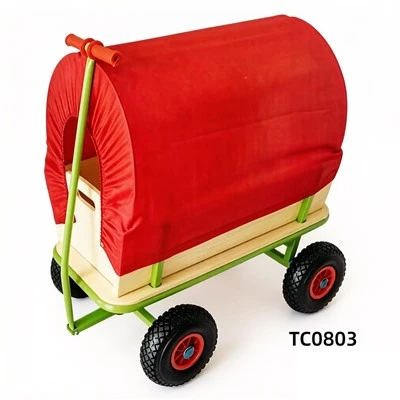
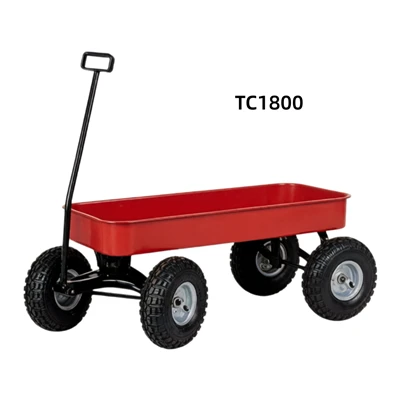
Now, before you write off the idea entirely, let’s talk about the scenarios where a garden cart can actually be used to transport a playhouse, because it is possible—you just have to do it right. First, you need to pick the right kind of garden cart. Not all garden carts are the same, and some are better suited for odd, bulky loads than others. For example, a two-wheeled garden cart (often called a wheelbarrow cart) with a high, wide bed works far better than a four-wheeled utility cart with a narrow, low bed. Why? The two-wheeled design lets you adjust how you position the load to keep the center of gravity low, and the wider bed gives you more space to distribute panels without overcrowding. We also make garden carts with built-in side rails that extend up 12 inches, which is enough to keep a playhouse panel from sliding out during transport. Another key feature: pneumatic tires, not plastic. Plastic tires are stiff and make the cart bounce over even small bumps, which shifts loads. Pneumatic tires absorb shock, so they keep the playhouse panel stable as you move.
Then, you have to adjust how you load the playhouse, not just heave pieces into the cart. The most effective method we’ve tested with our own customers is to disassemble the playhouse fully, separate the lightweight plastic or trim pieces from the main wall and roof panels, and then arrange the largest, heaviest panels first in the cart. Place them standing up, leaning against the extended side rails, not laid flat—this keeps their center of gravity lower, so they’re less likely to tip. For extra balance, tuck the smaller, lighter pieces (like window frames, doors, and trim) between the large panels, like filling a puzzle, to create a solid, stable block. Then, use heavy-duty ratchet straps, not flimsy bungee cords, to secure the load—run one strap across the top of the panels, one across the middle, and one across the bottom, so even if you hit a bump, the load doesn’t shift. We tested this method last spring with a customer in Michigan who needed to move a 6-foot wooden playhouse 100 feet across his yard to make space for a new garden bed. He used our two-wheeled garden cart with extended rails, arranged the panels standing up, and secured them with three ratchet straps. When he got to the new spot, all the panels were scratch-free, no parts were broken, and the playhouse went together perfectly. That’s the win case, but it requires careful loading, not just tossing pieces in.
There’s another angle to this question that many people miss: what about moving an assembled playhouse? Can you move a playhouse that’s already fully put together with a garden cart? The short answer is almost never. Assembled playhouses have a rigid structure, but they’re not designed to be transported. Even the sturdiest wooden playhouse has seams between panels that can split when twisted or jostled during transport, and the roof is only screwed on loosely enough to stay in place when it’s sitting still, not when it’s being bounced over grass or pavement. We did a small test with our team last year where we tried moving a fully assembled 8-foot playhouse (with the owner’s permission, of course) with a heavy-duty four-wheeled garden cart. We went 50 feet over a smooth driveway, and when we stopped, the back wall panel was split 6 inches from the corner, and three roof shingles had fallen off. The playhouse was still usable, but it required repairs that would have been unnecessary if we’d disassembled it first. If you’re moving a playhouse any distance over even slightly uneven ground, disassembling it is non-negotiable—garden carts aren’t flatbed trucks, and they can’t handle the constant vibration that comes with moving a large assembled structure.
Now, let’s address the “why bother” part, because there’s a common alternative here: renting a small pickup truck or using a trailer. For many people, that makes more sense, especially if they’re moving the playhouse more than 100 feet. Pickups have a larger bed, and they’re designed to transport heavy, bulky loads over longer distances without the risk of tipping or breaking. But that’s not always an option—some people don’t own a truck, don’t want to pay for a rental, or live in a tight neighborhood where parking a truck at their house is a hassle. That’s where the garden cart works, but only if you follow the rules we’ve laid out.
As a garden cart supplier, this is the kind of practical, real-world advice we love to give, because we don’t just sell carts—we help people use them for the jobs that make their yards better, whether that’s hauling mulch, moving playhouses, or planting a new vegetable garden. We’ve built our business on making carts that are durable, versatile, and designed to work with the irregular stuff that comes up in home and yard projects, and moving a playhouse is one of those jobs that’s possible with the right cart and the right approach.
Wait, let’s circle back to that initial question one more time to make sure we’re clear: yes, you can use a garden cart to transport a child’s playhouse, but only if you disassemble it, use a cart with extended side rails and pneumatic tires, load the panels standing up to keep the center of gravity low, and secure every piece tightly with heavy straps. Skip any of those steps, and you’re very likely to end up with a scratched playhouse, broken parts, or even a damaged cart—and that’s a waste of time and money for a project that’s supposed to be fun for your kid.
If you’re ready to pick the right garden cart for moving playhouses or any other yard project, we’re here to help. Our team has years of experience testing and using our carts in real yards, and we can answer any questions you have about loading, transport, or finding the right model for your space. We offer flexible options for both small and large projects, and we’re happy to talk through your specific needs, whether you’re moving a playhouse across the yard or hauling supplies for a weekend garden project. To learn more and start a conversation about the best solution for your next project, reach out to our team for a consultation.
Garden Carts References:
- American Society of Agricultural and Biological Engineers. (2019). Load Stability Guidelines for Wheelable Yard Equipment. ASABE Standards.
- National Home Gardening Club. (2021). Guide to Disassembling and Moving Outdoor Play Structures. National Home Gardening Club Publications.
- Journal of Outdoor Recreation and Design. (2020). Structural Integrity of Prefabricated Wooden Playhouses During Transport. Vol. 12, No. 3.
Qingdao Herzhe Tools Manufacturing Co., Ltd.
Qingdao Herzhe Tools Manufacturing Co., Ltd. is one of the most professional garden carts manufacturers and suppliers in China. We have world-leading production equipment and strong manufacturing capabilities. Please feel free to buy advanced garden carts at competitive price from our factory.
Address: No. 406 Shuangfushan Road, Baoshan Town, Qingdao CHINA
E-mail: herzhetool@163.com
WebSite: https://www.herzhetoolsmfg.com/
