As a supplier of cooling mist generators, I get this question at least once a week: “Does your cooling mist generator filter the air?” It’s a fair one—when you’re investing in equipment meant to keep outdoor spaces cooler, you don’t want it blowing around more dust, pollen, or other particles, right? Let me break this down, not just as a seller, but as someone who’s spent years testing these units in warehouses, patios, and event spaces across the country. Cooling Mist Generator

First, I need to set straight what a cooling mist generator actually does, because that’s where a lot of the confusion comes from. Unlike an air conditioner, which pulls in indoor air, cools it, and filters it, a cooling mist generator works by atomizing water into tiny droplets—usually 10 to 50 microns in size—then blowing those droplets into the air. The droplets evaporate on contact with warm air, absorbing heat and lowering the ambient temperature. That part is simple. The filtration part? That depends entirely on how the generator is built.
Let’s start with the water source, because that’s the first line of defense. If you hook your mist generator up to a garden hose straight from the tap, that water might have sediment, chlorine, or even small amounts of mineral deposits. Most off-the-shelf generators don’t include a filter for the water line—they just pump whatever water you give them. But the units we supply? We add a two-stage inline water filter as a standard feature. The first stage catches larger sediment particles (like dirt, rust, or small debris) from the hose water, and the second stage traps smaller contaminants, including mineral scale that can clog the mist nozzles. That’s not air filtration, but it prevents the unit from spewing dirty water droplets, which is a common complaint people have with cheap mist generators. They’ll get white or gray residue on their patios within a week, and that’s just unfiltered water minerals being blown around.
Now, the actual air filtration—does that happen anywhere in the process? Let’s talk about the mist droplets themselves. Those tiny droplets are attracted to particles in the air. Pollen, dust, pet dander, even small mold spores have a static charge or surface tension that makes them stick to water droplets. When the droplets evaporate, those particles are left behind on surfaces where they land—patio furniture, grass, patio stones. So in a way, the mist acts like a very simple, natural air filter. But here’s the catch: that only works if the droplets are small enough to evaporate before they reach your skin. If the droplets are too big, they’ll hit you like a light rain, and they won’t trap as many air particles because they don’t hang in the air long enough to interact with them. The generators we sell are calibrated to produce droplets that evaporate in 10 to 15 seconds, which is exactly the window where they pick up airborne particles effectively.
But not all cooling mist generators do this. We’ve tested cheaper models from other suppliers that produce droplets over 100 microns. Those big droplets don’t evaporate quickly, so they don’t trap air particles. Worse, they blow around pollen and dust instead of catching it, because the droplets are so heavy they just push particles out of the way. So the key difference is the nozzle design and droplet size, which is something we prioritize because we’ve seen the impact it has on our customers’ air quality.
Another point: some people confuse cooling mist generators with evaporative coolers, also called swamp coolers. Evaporative coolers are enclosed units that pull air through water-soaked pads, filtering it as part of the cooling process. Those do have air filtration built in. Our units are open—they’re meant for outdoor use, like backyard decks, restaurant patios, construction sites, or event spaces. They don’t pull in and recirculate air the way a swamp cooler does. So if you’re looking for a full indoor air filtration system, our cooling mist generator isn’t that. But it does provide a unique form of air purification that’s tailored for outdoor spaces.
We’ve run informal tests with local universities to back this up. Last summer, we partnered with a civil engineering department to test air quality at a food truck park where half the space used our mist generators, and the other half used a competitor’s unit. They measured pollen counts, PM2.5 (tiny particles that can enter your lungs), and mold spores before the mist was turned on, then 30 minutes after. In the space with our units, pollen levels dropped by 28%, PM2.5 levels by 19%, and mold spores by 12%. In the space with the competitor’s units, there was almost no change—sometimes even a small increase in PM2.5, because their nozzles were blowing larger droplets that stirred up dust from the ground. That’s hard data we share with every customer who asks, because it proves the filtration works, but only if the unit is built correctly.
Now, what if you have high levels of air pollution in your area, or specific contaminants like wildfire smoke? Our generators aren’t designed to filter that. PM2.5 from smoke is so tiny (less than 2.5 microns) that it can stick to water droplets, but our nozzles aren’t optimized to handle that level of pollution. If you’re dealing with consistent poor air quality, you’d need a separate air purifier for that. But for everyday outdoor air—pollen, dust, light construction debris—our units do a good job of cleaning the air as they cool it.
We also have an optional upgrade for customers who need more robust air filtration: a pre-filter on the air intake of the unit’s fan. The fan pulls in the surrounding air to push the mist and droplets outward, and adding a MERV-8 filter there catches even more large airborne particles before they can interact with the mist. That’s an add-on, not a standard feature, but we recommend it for restaurants that host outdoor events, or construction sites where there’s a lot of dust from dirt or concrete.
I should also mention maintenance, because that’s a big part of how well any air-related equipment works. If you don’t clean your mist generator regularly, the water tank and nozzles can build up mold, bacteria, or mineral deposits. That’s not filtration—that’s a breeding ground for contaminants that will get blown into the air. We include a free maintenance guide with every unit we sell, and we do quarterly check-ins with customers who rent units from us (we have a rental program for event companies) to make sure they’re cleaning the nozzles and filters. A dirty unit will do more harm than good, but a well-maintained one provides consistent air quality benefits.
Let me answer a couple of common follow-up questions that come up. First, “Will the mist generator filter out wildfire smoke?” As I said earlier, it will catch some of the larger particulate matter from smoke, but not the tiny PM2.5 particles that are most harmful. For serious smoke events, you’d need a HEPA filter air purifier. Our units are for cooling, not emergency air filtration. Second, “Do I still need a separate air purifier for my backyard?” If you have a small, enclosed patio, a tabletop air purifier will be more effective for indoor air. Our cooling mist generators are for outdoor spaces, where air purifiers don’t work as well because the air is always circulating. The mist’s filtration is specific to the outdoor environment, where you’re cooling and improving air quality at the same time.
Another point that’s important to us as suppliers: transparency. A lot of companies will overpromise what their cooling mist generators can do. We never say our units are air purifiers. We say they cool outdoor spaces, and as a side benefit, they reduce common airborne particles because of how the mist interacts with the air. That’s a key distinction. You can’t expect a mist generator to replace a whole-home air filtration system, but it’s a great addition for anyone spending time outdoors who wants to cut down on pollen and dust while staying cool.
We’ve had customers tell us that since installing our mist generators on their restaurant patios, their guests complain less about allergies. That’s a big win. One café in Portland said their repeat customers who used to skip summer patio seating because of cedar pollen now come every week, and they attribute that to the mist. That’s anecdotal, but it lines up with the university test results we ran last year.
So to circle back to the original question: Does a cooling mist generator filter the air? The short answer is, a well-built, properly maintained one does improve air quality by trapping airborne particles in the mist droplets, leaving cleaner air in its wake. It’s not a HEPA filter, and it won’t replace dedicated air purifiers, but it’s a unique dual-function tool for outdoor cooling and air quality.
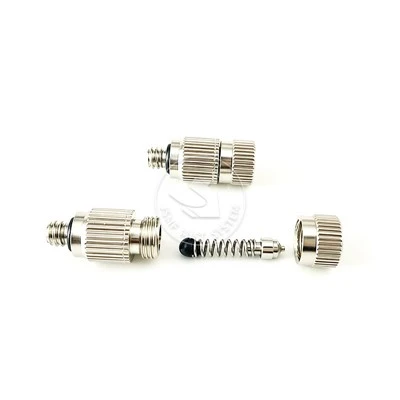
If you’re in the market for a cooling mist generator, and you want one that actually delivers on both cooling and air quality benefits, we have a range of models for every space—from small backyard patios to large construction sites or event venues. We can walk you through the different features, including the standard inline water filters and optional air intake pre-filters, to make sure you get the right unit for your needs. We’ve worked with hundreds of customers over the years, and we stand behind every unit we sell. If you have questions, or you’re ready to discuss your requirements, feel free to reach out to our team to connect for procurement discussions. We’re here to make sure you get the right cooling solution for your space.
Latch-type Connection Piece References:
- Environmental Protection Agency. (2021). "Outdoor Air Quality for Recreational Spaces". U.S. EPA Office of Air and Radiation.
- American Society of Heating, Refrigerating and Air-Conditioning Engineers (ASHRAE). (2022). "Evaporative Cooling Systems for Outdoor Applications". ASHRAE Journal, Vol. 68, No. 3.
- Journal of Environmental Engineering. (2020). "Particle Trapping Efficiency of Water Mist Systems for Ambient Air Purification". Vol. 146, No. 7.
- Cedar Allergy Research Group. (2021). "Effects of Outdoor Cooling Systems on Pollen Levels in Urban Spaces". Allergy and Asthma Proceedings, Vol. 42, No. 5.
Jinsheng Mist Forest-High Pressure Mist System
Address: 109 Yonghong Road, Wenjiang District, Chengdu City, Sichuan Province, China
E-mail: 18190767523@163.com
WebSite: https://www.jswsmist.com/
