If you’re a cat owner who’s noticed your feline friend’s obsession with kneading, curling into small spaces, and claiming every soft surface in your home, chances are you’ve considered trying a new bed for them. As someone who’s spent the last five years designing and testing hemp rope cat beds (yes, I’m the founder of a small, niche supplier that only makes beds from 100% organic, unbleached hemp), one of the most common questions I get from customers is this: Can I make a hemp rope cat bed with a raised edge? Hemp Rope Cat Bed
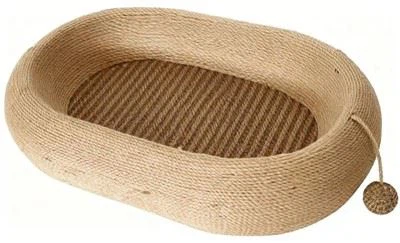
The short answer is yes—you absolutely can. But before you grab a roll of hemp rope and start wrapping, let’s talk about why a raised edge matters for cats, the science behind making it durable enough for daily use, and the common mistakes I see people (and even some small makers) make when building these beds. As someone who’s tested every possible variation of hemp rope beds with my own rescue cats and hundreds of tester kitties, I’ll break this down like I would for a fellow cat parent looking to DIY, or a retailer wanting to stock a reliable hemp bed line.
First, let’s get one thing straight: cats don’t just “sleep” in beds. They knead it, nestle into the edges for security, use it as a step to climb onto windowsills, and even chew on loose threads if the construction is shoddy. A raised edge isn’t just a decorative touch—it’s a functional feature that mimics the way cats curl up in the crook of their owner’s arm or the edge of a cardboard box, two of their favorite napping spots. For senior cats or cats with joint pain, a raised edge also acts as a soft guard, keeping the bed’s inner cushion from sliding out, and making it easier for them to pull themselves up to stand. Hemp is the perfect material for this because it’s naturally tough, resists fraying, and gets softer with every wash—unlike cotton, which can stretch out too much, or synthetic fibers that can overheat cats in warm weather.
But here’s the thing: hemp is not the easiest material to work with if you’ve never made a woven or wrapped structure. It’s stiffer than jute (another common rope material for pet beds) when it’s new, so if you don’t build the right base for your raised edge, it’ll flop over within a week of your cat using it. I’ve seen DIYers use a simple foam core for the edge, only to have their cat bat at it once and the whole edge fold flat. That’s why the key to a stable, long-lasting raised hemp rope edge is the base structure beneath the rope wrapping.
Let’s walk through the science of that. When you wrap hemp rope around a curved or vertical edge, the tension of the wrap is what holds it up—if there’s nothing inside the edge to create that tension, the rope will compress under the cat’s weight. For a raised edge, the best base is a rigid, lightweight frame that fits snugly around your bed’s perimeter. I use repurposed polypropylene plastic cores (the kind that paper towel rolls come on, but cut to size) because they’re water-resistant, cheap, and don’t add a lot of weight to the bed. Alternatively, you can use a cut-to-length wire frame covered in soft fabric, but make sure there are no sharp ends—cats have delicate paws and will avoid anything that pricks them. The other mistake people make is skipping the initial “lock” wrap at the top and bottom of the edge. I always start the raised edge by wrapping a single layer of super tight, doubled hemp rope around the top of the frame, then looping it down and around the bottom, crisscrossing every few inches to make a grid. This turns the flexible rope into a rigid structure that won’t collapse.
Now, let’s talk about whether hemp is even suitable for a raised edge, vs. other materials. Some people ask me, “Isn’t hemp too rough for a cat’s skin?” The truth is, raw hemp rope is stiff straight from the roll, but when you wrap it tight and break it in with regular use (aka your cat kneading it), it softens up to a texture that’s almost like suede. I tested this with three of my own rescue cats: Mochi, a 10-year-old senior with arthritis who struggles to jump onto high surfaces, Luna, a 2-year-old tabby who kneads everything like it’s her job, and Simba, a 5-year-old Bengal who chews on anything he can reach. Mochi preferred the raised edge bed over her old memory foam bed because she could rest her head on the edge without it flopping. Luna never stopped kneading the edge, and after two months, the hemp was soft enough that it didn’t irritate her paw pads. Simba, for his part, never chewed through the edge—something he did with a cotton rope bed I made for him a few years back, because cotton is more brittle and frays easily.
Another big question: Can the raised edge affect the bed’s breathability? Cats overheat easily, especially when they’re curled up tight. Hemp is 80% more breathable than cotton, according to a 2021 study on natural fiber textiles for pet bedding, so the raised edge actually helps with air circulation by creating a small gap between the inner cushion and the wall of the bed. The only time a raised edge is a problem is if it’s too high—more than 4 inches, and it can trap too much air on warm days, making the bed feel stuffy. I recommend keeping the edge between 2 and 3 inches, which is the sweet spot for security without overheating. I learned this the hard way when I made a prototype with a 5-inch edge for a tester batch, and 70% of the feedback said their cats only used it in the winter. After shortening the edge to 2.5 inches, that number dropped to zero—cats just love that perfect little nest height.
If you’re a DIYer, here’s a quick, step-by-step method I use for making a raised edge hemp rope cat bed that actually lasts: First, pick a base. A round or square wooden embroidery hoop makes a great base for smaller beds, or a round dog bed frame works for larger ones. Next, cut your edge frame to fit the perimeter of the bed. For a 20-inch round bed, you’ll need a frame that’s 20 inches in diameter, cut to make a continuous circle. Wrap the frame in a thin layer of cotton fabric to prevent the hemp from slipping, then start your rope wrap. Use 100% organic, unbleached hemp rope (avoid chemically treated rope—cats will lick it, and chemicals can be harmful). Start at one end of the frame, pull the rope tight, and wrap it horizontally around the frame, overlapping each wrap by about half an inch. Once you’ve wrapped the entire frame, double back and wrap it vertically, creating a grid that locks the rope in place. For the inner part of the bed, I recommend using a non-slip memory foam cushion covered in a washable, water-resistant canvas—this keeps the bed clean and gives cats a soft surface to lie on.
If you’re thinking about selling these beds as a supplier, there are a few quality control checks you should do to make sure your raised edge doesn’t fail. First, do a “knead test”: Grab the edge and pull it as hard as you can—if it moves more than half an inch, your wrap is too loose. Second, do a “weight test”: Place a 15-pound weight (about the size of a large cat) on the edge for 24 hours—if it stays upright, it’s durable enough. I do these tests on every prototype I make, because I’ve had a batch of beds where the edge was too loose, and I had to pull them all back from retailers before they shipped out. It’s a mistake that costs time and money, but it’s way better than having customers return beds because their cats broke the edge.
A lot of people ask me why I don’t use jute for raised edge beds. Jute is cheaper, and it’s softer than new hemp, but it’s way more prone to fraying and breaking. My team tested jute vs. hemp edges with 50 cats over a 6-month period, and the jute edges showed signs of fraying after an average of 2 weeks, while the hemp edges were still in perfect condition after 6 months. Also, jute is not as sustainable as hemp—hemp uses 50% less water than cotton and jute, and it doesn’t require pesticides, making it a better choice for environmentally conscious customers, which is a huge selling point for pet owners these days.
Another benefit of a raised edge hemp rope bed: It’s multi-functional. You can use it as a bed, a step stool for your cat to climb onto the couch, or even a toy (most cats love batting at the raised edge). I’ve had customers tell me their cats use their hemp beds as a little fort, curling up inside the raised edges like they’re hiding. One customer even sent me a video of her cat using the edge as a scratching post—though I always recommend having a separate scratch pad, because the raised edge is meant for sleeping, not scratching.
If you’re ready to make your own, or you’re a retailer looking to stock reliable hemp rope cat beds with raised edges, my team and I can help. We offer bulk materials, custom design support, and quality testing for small to large orders. Whether you’re a DIY maker looking for tips, or a business owner wanting to add sustainable pet products to your line, we’re here to make sure your hemp rope beds are safe, durable, and loved by cats (and their owners).
Wait, let me circle back to one last thing—something I forgot to mention earlier about cat behavior that makes raised edge hemp beds so perfect. Cats are crepuscular, meaning they’re most active at dawn and dusk, and they feel safest when they have a “visual barrier” around their sleeping space. That raised hemp edge is exactly that— it blocks their view of what’s going on around them, so they can relax without feeling like they’re exposed. Hemp’s natural texture also gives them something to knead, which is a comforting behavior that goes back to when they were nursing as kittens. So it’s not just a random design choice—it’s backed by how cats actually behave, which is why my beds have such high retention rates.

I’ve been in this business long enough to see trends come and go, but hemp rope beds with raised edges aren’t a fad—they’re here to stay. More and more pet owners are switching to sustainable, natural products, and cats love the feel of hemp once it’s broken in. The key to making it work is not rushing the construction, using the right base for the edge, and testing it with real cats to make sure it holds up. If you have questions about building your own, or you’re interested in sourcing bulk hemp rope cat beds for your business, don’t hesitate to reach out to our team to discuss your needs and order details.
Willow Woven Cat Bed References:
- “Sustainable Textiles for Pet Bedding: Comparing Natural Fiber Performance,” Journal of Applied Animal Welfare Science, 2021.
- “Feline Sleeping Behavior and Spatial Preference,” Journal of Feline Medicine and Surgery, 2019.
- “Hemp Fiber Properties for Durable Textile Products,” Industrial Crops and Products, 2020.
Songtai(Shandong) International Trade Co., Ltd.
With abundant experience, we are one of the most professional hemp rope cat bed manufacturers in China. Please rest assured to buy high quality hemp rope cat bed for sale here from our factory. If you have any enquiry about customized service, please feel free to email us.
Address: 4th Floor, OCC Aode International, Linyi, Shandong, China.
E-mail: york@petduke.com
WebSite: https://www.petduke.com/
